


“Is he OK? Why is he on the floor?”
We filed into our first real graphic design class at the University of Cincinnati. We’d completed a year of introductory courses, but this was when the proper studio classes began. We all knew of Gordon Salchow—and as we entered the classroom we did not expect him to be sitting on the floor, quietly flipping through a magazine.
Gordon’s reputation preceded him. He arrived in Cincinnati in 1967 to found the graphic design program at UC, so he had been developing his peculiar approach to teaching for 25 years when I started in 1992.
There were rumors. Michael Bierut, who graduated from the same program twelve years before I did—and would later become a partner at the venerable design firm Pentagram—recalled Gordon’s looming reputation in Design Observer.1
“Rumors about Salchow began to circulate in whispers among my classmates. He gave cryptic assignments that were sphinx-like in their inscrutability. He said things in critique sessions that made students burst into tears. He lived in a featureless white box.”
We’d heard these same rumors, plus one more: during the coming quarter, Gordon would cut someone from the class—a necessary culling to keep the standards high. He would clearly and directly suggest to at least one of us that a different discipline might be a better fit—architecture, perhaps.
Which of us lacked the mettle of a graphic designer?
And why was our legendary, feared professor seated crosslegged on the floor at the front of the classroom?
He wore an oversized, bold-patterned sweater, reading glasses perched at the end of his nose, with a high part in his blond hair that fell over his forehead. He frowned between sips from a steaming, stainless steel, perfectly cylindrical coffee mug—and paid us no attention. We shifted uneasily on our stools—exchanged quizzical looks and shrugged shoulders. The brave whispered.
Twenty minutes into class, we were growing accustomed to him sitting quietly on the floor.
And then he shouted:
“DECISIVE!”
Some of us fell off our seats—he grabbed my attention—but only for the moment.
Over the next twelve weeks, Gordon assigned a series of painfully pedantic exercises meant to teach fledgling designers the foundations of graphic design.
This fledgling designer, however, saw no connection between those exercises and the fantastic, meaningful, important things I imagined myself creating—posters, logos, signage systems. Work that people would see, recognize, appreciate—even love. Graphics that saved lives!
I was ready for that.
But first, I had to complete these abstract, tedious, meaningless little projects.
To start, he required us to interrupt 5x5 white squares with vertical black intervals. I remember finishing the project in about 10 minutes. Thank you, next project please.
But every time he inspected my work, he posed questions I could not answer.
How many stripes should there be?
These black stripes are nearly the same width? Why not the same?
How wide should the white spaces between the black stripes be?
These intervals gradually increase in size across the square—why so haphazardly?
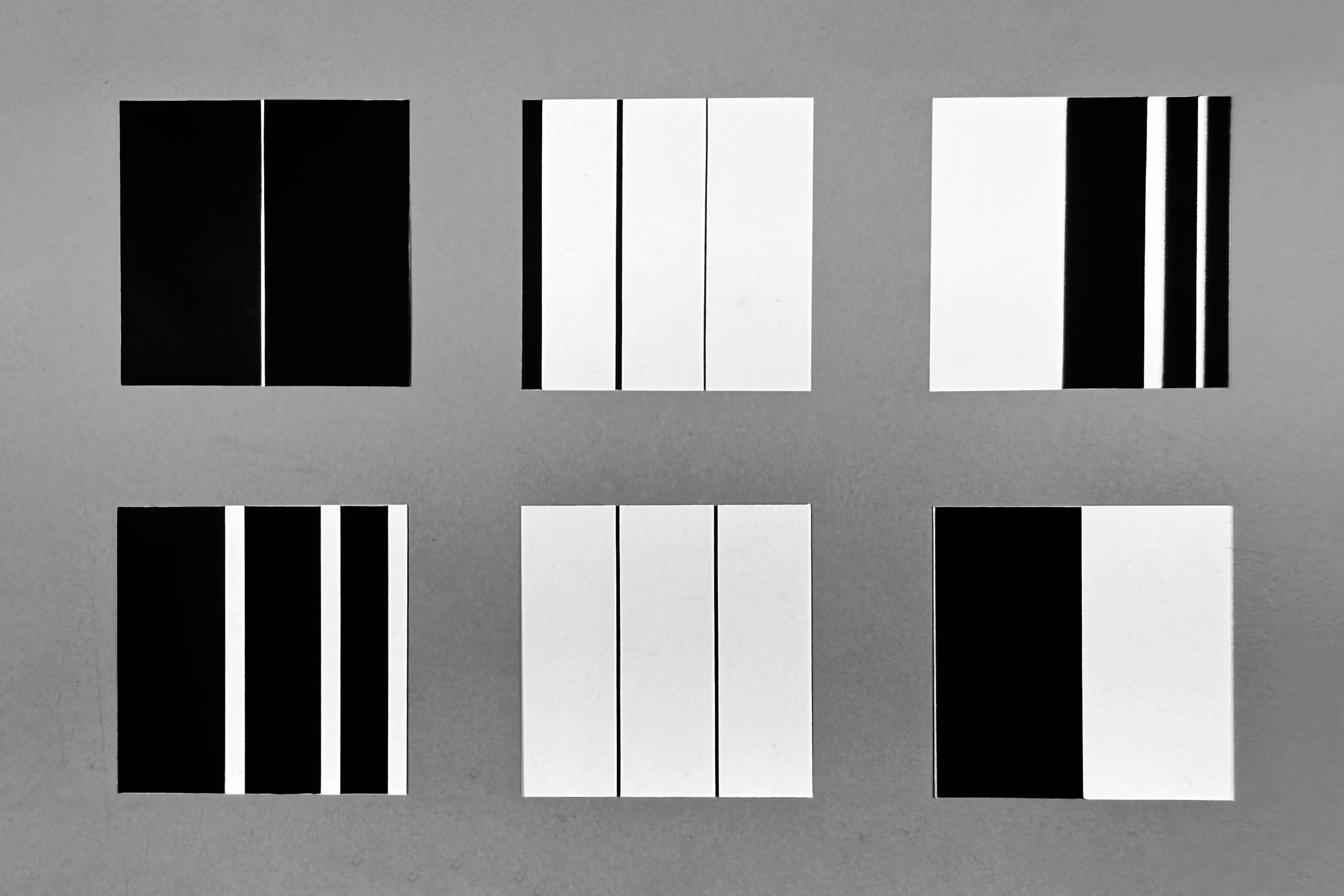
All these little decisions weren’t worth my attention. I wanted to be done with his questions.
Then came the key.
We could pick any key—a door key, a car key, the tiny key to lock our diaries where we reflected nightly on the painful rituals of graphic design school.
This key became the subject of three projects in the final weeks of the quarter. We were to create three images of the key, each several times the key’s actual size. Simple black and white silhouettes. Not drawings technically, but paintings, painstakingly executed in a nearly extinct form of opaque watercolor called Plaka.
The first assignment was straightforward: a silhouette of the key, rendered exactly as it was.
The second: redesign the key—refine it, improve it somehow, without losing its identity.
The third: capture the essence of the key. Huh? My key had no essence.
I tried to move quickly through each phase.
But each time, Gordon held my key between his thumb and forefinger—scrutinizing it. Then he analyzed my paintings just as precisely.
The juncture of these two edges is rounded. You’ve drawn a fine point?
This upper edge is just out of parallel with this bottom edge. Why is yours parallel?
Should these two shapes be the same? Or different?
This pattern is nearly perpendicular to this edge? Why not precisely?
I was sure he was making stuff up—but even if I agreed with his observations, I couldn’t see what difference it made. What was the point? He kept sending me back to the drawing board.
He never told me what to do. He told me what he saw—and implied I was not done. Everything was connected. Changing one detail meant I had to chase another detail somewhere else. The project would never be finished, and I was running out of time in the semester. In the hours before the final critique, I quickly finished the third drawing.

At the end of the semester, each student was assigned a room. We pinned our work to the walls and waited. One by one, our professors entered—moving from room to room, spending about twenty minutes with each of us, talking about our twelve weeks worth of work.
Gordon was the last professor to enter my room. He frowned as he placed his steaming, stainless steel, perfectly cylindrical coffee mug on the table.
Why are you studying graphic design?
My chin dropped to my chest. My stomach hit the floor.
I processed the realization that I was being cut. Ousted. I was the fat to trim. The admissions mistake to correct.
He lectured me for 20 minutes, but he didn’t look at or mention my work on the wall.
Do you enjoy graphic design? Why are you always so eager to finish?
Gordon slowly exited the room, leaving me weak with emotional and physical exhaustion. A few curious classmates tiptoed into the aftermath. They offered hesitant assurances—that this wouldn’t be the end of my graphic design studies. Hey—architecture isn’t so bad?
Thankfully, no letter from the admissions office ever arrived and I continued in the program.
In the coming quarters of study, the projects gradually became more complex and “real.” I drew my own funny coffee mug, designed a symbol of a wasp, an icon system for a service station, and some posters for a made up concert series.
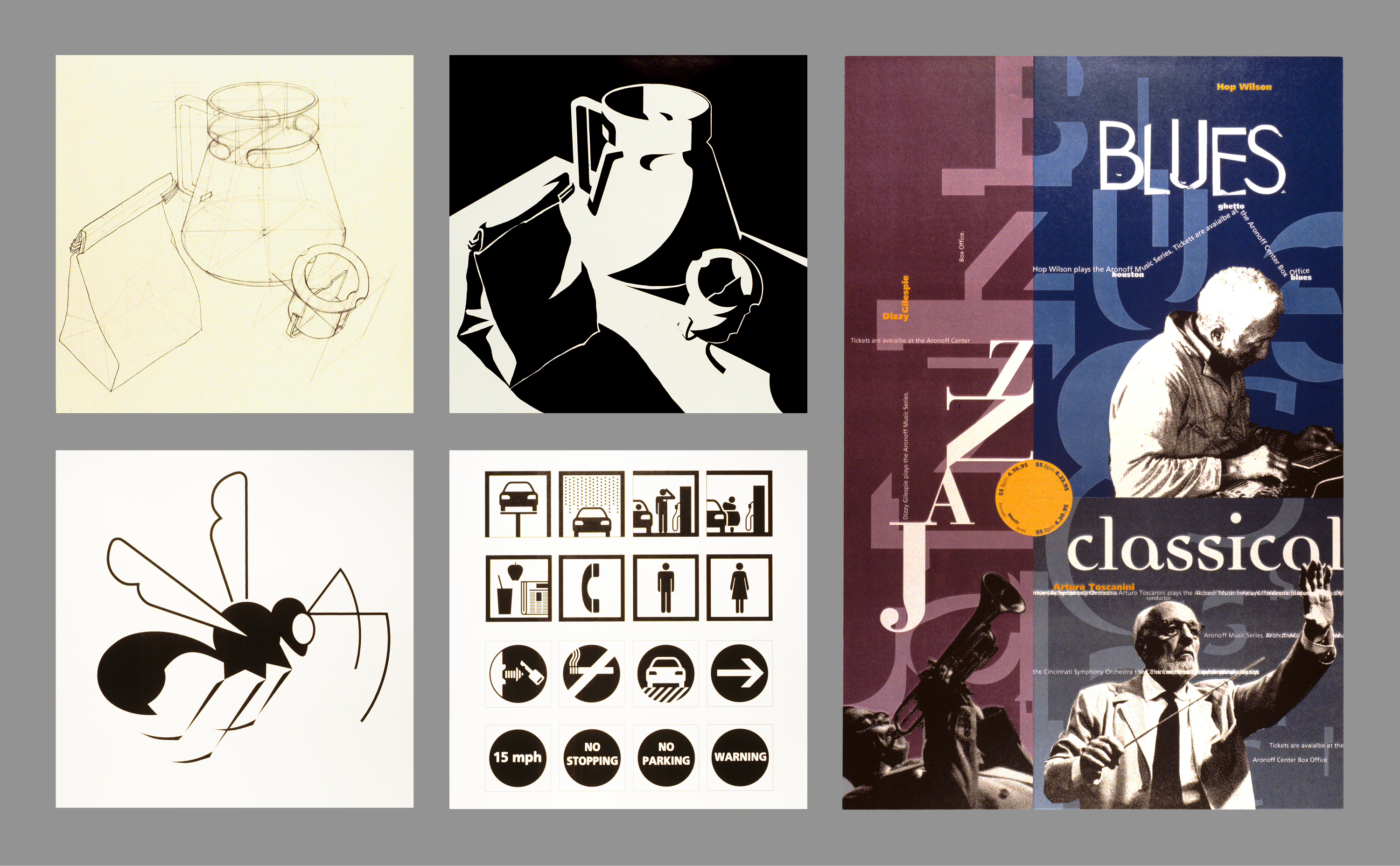
I relished these more advanced projects. Part of me reluctantly embraced the idea that each project was an opportunity to practice being decisive and intentional about every mark I put on the page. I started to find joy in doing the project, not just the finishing.
How should these antennae extend from the head?
Should these lines connect?
How many dots should indicate the falling water in the carwash?
What size dots?
Which elements in the poster series should be contrasting?
Which ones should remain consistent?
Before our cap and gown graduation, the real commencement took place. Gordon invited the entire class to his featureless white box for brunch.
His house was cubical—but not featureless. It stood out in the leafy suburb of traditional houses. A pointy wooden deck protruded. Gordon’s tiny white Miata convertible was parked out front—just so. The inside was a museum of classic chairs we recognized from history class—so many chairs it was hard to move around. The bookshelves were stainless steel wire restaurant shelves—the height perfectly adjusted for the items on each shelf. No fake wood paneling was to be found in the house or his car, no fake embroidery anywhere—everything he owned met his exacting standards of design and quality.
I think this experience programmed something deep into the psyche of my classmates and me. Jim drives a Miata. Jeff and I have a lot of wire shelves. I’m sure many of us are working to fill our houses with chairs. But he inspired more than future purchases.
Foundations courses are standard in most design programs—typography, color, composition, form. Those are essential, and Gordon, along with the rest of the faculty, prepared us well on those fronts.
But in those twelve weeks with Gordon, I think I started to learn something less visible as well. Lessons that lie beneath the foundation.
It’s hit me in waves in the years after Gordon’s classes, but it’s there that he planted the seeds. I’ve learned to be decisive and intentional in the full spectrum of design decisions—not just the visual ones, but the broader decisions: how a project is defined, where to look for insight, and which ideas are worth building. It’s also where I began to worry less about finishing—and to find joy in the work itself.
For five years, I’ve taught Foundations of Interaction Design at California College of The Arts, evolving how I teach the course each year. There’s so much to cover—the classic foundations still matter—typography, form, color—but now there are additional layers. Designers are expected to know interaction design, motion, user research, writing, storytelling, systems thinking, coding, business models, and an unending stream of AI tools that demand integration into practice. And in design education more broadly, there’s pressure to squeeze all of this into shorter and shorter degree programs.
Meanwhile, students face an onslaught of distractions I never had to deal with in school.
If I started my students with Gordon’s gauntlet of exercises, I’d have an insurrection on my hands. I don’t blame students for wanting to skim or skip ahead. But I do want them to learn how to be decisive and intentional, and to love the work of making things. Not only the big showy things we get to make—but also the long tail of smaller, hidden design decisions. Finding joy there is key to a satisfying career and for making the world a better place.
Gordon passed away on October 4, 2019. He dedicated his career to teaching design, and after 52 years at the University of Cincinnati he would have taught over 1000 students directly and reached many more with his writing and presentations. Each of Gordon’s students have headed out into the world to practice design, each of us likely taking something a little different from our time with him, but the ripple effects from a teaching career like that are difficult to overestimate.
As I got to work refining my syllabus for this semester, I found myself prioritizing the fundamental lessons I learned from Gordon—even as I experimented with new ways to compress everything into the 15 short weeks I have with my students. I hope the class offers a solid foundation—not just for their one-year journey toward a Master’s degree, but for the uncertain world of work that lies beyond it. I hope my students see that these lessons apply not only to the things we get to help make, but also to how we live our lives.
I wish I’d realized sooner—and made the effort to tell Gordon directly—how decisively he shaped my career, my teaching, and life.
Thanks, Gordon.
More thanks:
Big thanks to Robert Probst, my former professor who is now Dean Emeritus of the College of Design, Art, Architecture, and Planning at UC. He dug through the archives for these images. When it was his turn during the final critique, he walked into my room and said, “Hi Frank!” Thanks, Robert.
Matthew Gaynor advised me on an independent study project when I made the music posters. I once complained to him that everything was shit—he suggested I stick my hands into it and make something out of it. A man of few words—he chooses them wisely. Thanks, Matthew.
Joe Bottoni taught the class where I drew the wasp symbol. He was always available for an after-hours conversation about whatever I was struggling with. He once told me I wouldn’t be happy until I was working for myself, and at another point said, “You’re very pragmatic, aren’t you, Matt?” Over twenty years later, I named my solo consulting practice Pragmattic. Thanks, Joe.
Yet further acknowledgments:
Classmates from UC who helped me recall details and fill in blanks: Jeff Tull, Chris Gliebe, Cybele Grandjean, Brian Cox.
Writing buddies who read of the many drafts of this story: Michael Dean, Cam Houser, Dominik Gmeiner, Aaliah
Bierut, M. (2019, October 7). Remembering Gordon. Design Observer. https://designobserver.com/remembering-gordon/
Actual tears. You’re a great writer, and I truly appreciate this time traveling nostalgia ride. Gordon was a skyscraper. Thanks Beeb.
…natch on this being some of your most !DECISIVE! writing too…there are many ways to be a good teacher, and as you show. one is to challenge the student to the point of questioning purpose/truth/value of the art/study…i’ll never forget my professor of katharsis ahuvia kahane (still teaching) who kicked me out after two late arrivals…he was correct…and i’ll never forget it…